
Braces vs Clear Aligners in Indore — Which Is Right for You? (2026 Comparison)
If you have been told you need orthodontic treatment, you have probably already encountered the central question: braces or clear aligners? Both straighten teeth. Both are effective. But they work differently, cost differently, and suit different types of people. Choosing the wrong one for your situation wastes time and money.
Dr. Shailly Nimbark (BDS, MDS Orthodontist, Dream Smile Dental Clinic, Indore) answers this question for dozens of patients every week. This guide gives you the honest, clinical comparison — without the marketing bias that often pushes patients toward the more expensive option.
How Each System Works
Braces
Brackets are bonded to each tooth and connected by an archwire. The wire exerts continuous gentle pressure that moves teeth over time. Adjustments are made every 4–6 weeks by tightening or changing the wire. Braces are fixed — they cannot be removed during treatment.
Clear Aligners
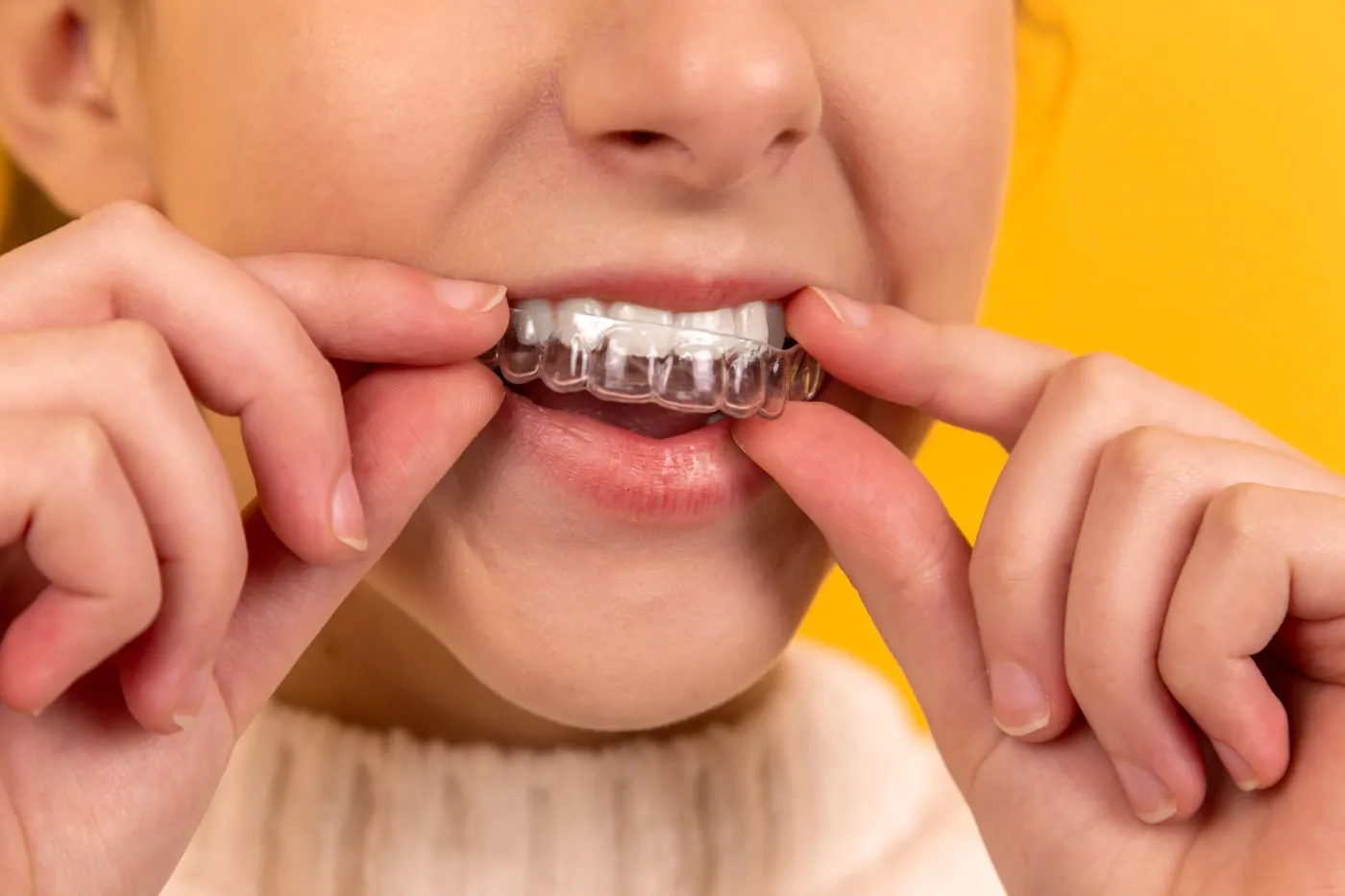
A series of custom-made, clear plastic trays (typically 20–40+ trays) are worn over the teeth. Each tray is slightly different from the previous one, progressively moving teeth toward the planned position. Trays are changed every 7–14 days. They are removable — taken out for eating, brushing, and special occasions.
Side-by-Side Comparison
| Feature | Traditional Braces | Clear Aligners |
|---|---|---|
| Visibility | Visible (metal or ceramic) | Nearly invisible |
| Removability | Fixed — cannot be removed | Removable (22 hrs/day required) |
| Cost (Dream Smile, Indore) | ₹20,000 – ₹35,000 | ₹45,000 – ₹80,000 |
| Treatment Duration | 12–30 months | 6–18 months (mild-moderate) |
| Case Complexity | All cases (mild to severe) | Best for mild to moderate |
| Eating Restrictions | Yes — no hard/sticky foods | None — remove to eat |
| Oral Hygiene | More challenging — plaque around brackets | Easier — remove to brush/floss normally |
| Compliance Required | Works regardless (fixed) | Must wear 20–22 hrs/day — high discipline needed |
| Emergency Repairs | Bracket may come off — clinic visit needed | Lost/damaged tray replaced — next tray used |
| Teeth Whitening During Tx | Not possible (brackets bonded) | Possible between trays |
| Best Age Group | Children, teens, adults (all ages) | Teens (with compliance) and adults |
When Braces Are the Better Choice
Choose braces if:
- ✅ Severe crowding — teeth significantly overlapping or rotated more than 45°
- ✅ Significant bite problems — deep overbite, underbite, severe crossbite
- ✅ Vertical tooth movements — intrusion (pushing teeth deeper) or extrusion (bringing teeth out) — aligners are less effective for these
- ✅ Children and young teens (under 12) — where compliance with removable devices is uncertain
- ✅ Budget is a significant concern — metal braces are 40–60% less expensive than aligners for comparable treatment duration
- ✅ Your case requires extractions — managing post-extraction spaces with aligners is more complex
When Clear Aligners Are the Better Choice
Choose clear aligners if:
- ✅ Mild to moderate crowding or spacing — aligners handle these efficiently
- ✅ Adults in professional or public-facing roles — near invisibility is a major social advantage
- ✅ Strong compliance habit — you will consistently wear trays 20–22 hours a day
- ✅ You play wind instruments or contact sports — brackets and wires are incompatible with these
- ✅ Gum disease concerns — easier to maintain oral hygiene (remove to brush)
- ✅ You want to whiten during treatment — possible between aligner changes
- ✅ Phobia of brackets and wires — dental anxiety is significantly reduced with aligners
What Clear Aligners Cannot Do (That Braces Can)
It is important to be realistic about aligner limitations:
- ❌ Severe rotations (more than 45°) — aligners struggle; braces manage these better
- ❌ Significant vertical movements — intrusion and extrusion are technically demanding for aligners
- ❌ Skeletal jaw problems — neither braces nor aligners alone fix jaw discrepancies. Surgery is needed for severe skeletal cases regardless of the appliance used.
- ❌ Unreliable wearers — aligners simply do not work if not worn. A compliant patient in braces will outperform a non-compliant patient in aligners every time.
Clear Aligners in India — Which Brands Are Available?
At Dream Smile Dental Clinic in Indore, we work with:
- Invisalign — the global market leader; 3D ClinCheck planning; 5–6 million patients treated worldwide; highest research support
- Toothsi / MakeO — Indian brand; more affordable; suitable for mild cases; direct-to-consumer but supervised by our team
- BRIUS / Spark — newer aligner systems with enhanced tooth movement capabilities
- Clear Correct — well-established alternative to Invisalign
Dr. Nimbark will recommend the aligner system most appropriate for your case and budget. Not every case needs Invisalign — and not every case can be adequately treated by a budget aligner brand.
The Compliance Question — The Most Important Factor Nobody Talks About
Here is the honest truth that aligner companies rarely advertise: clear aligners require extraordinary self-discipline. Trays must be worn 20–22 hours per day, every day, for the entire treatment duration. That leaves only 2–4 hours for eating and oral hygiene.
What happens if you under-wear?
- Teeth do not move as planned — trays start not fitting properly
- You need "refinements" (additional trays) — extending treatment and cost
- In severe non-compliance cases, treatment fails and must be restarted
For teenagers and anyone who knows they will struggle with discipline, braces are the safer, more reliable choice.
Frequently Asked Questions: Braces vs Aligners
Is clear aligner treatment as effective as braces?
For mild to moderate cases in compliant adults, yes — outcomes are comparable. For severe cases, complex bite problems, and younger patients, braces consistently produce more predictable outcomes. The effectiveness depends heavily on case selection and patient compliance with aligners.
Can I switch from braces to aligners mid-treatment?
Theoretically possible but rarely advisable — switching mid-treatment adds cost and complexity. The best approach is to choose correctly at the outset with a proper clinical assessment. Dr. Nimbark provides a clear recommendation at your first consultation based on your specific situation.
Do aligners work for overbite correction in Indore?
Mild overbites can be corrected with aligners using attachments (small composite bumps bonded to teeth that give the aligner extra "grip"). Moderate to severe overbites are managed more effectively with braces, which can use elastics and more precise archwire mechanics.
Which is faster — braces or aligners?
For mild cases, aligners can be faster (as short as 6 months). For complex cases, braces are typically faster because they can apply more precise and varied forces. Average treatment time for most patients is similar between the two systems when case complexity is matched.
Can I get clear aligners if I have had braces before?
Yes. Many adults who had braces in their teens and experienced relapse (teeth shifted after retainers were stopped) are excellent candidates for aligner retreatment — typically a shorter course (3–9 months) to correct minor relapse.
What is the cost difference between braces and aligners in Indore?
Metal braces: ₹20,000–25,000 (ceramic ₹30,000–35,000). Clear aligners (full course): ₹45,000–80,000. The cost difference is significant. However, if aligners are the correct clinical choice for your case, the investment in comfort and lifestyle convenience is often worthwhile for adult patients.
References: AAO — Braces vs Clear Aligners | PubMed — Clear Aligner Systematic Reviews
Not Sure Which Is Right for You? Let Dr. Nimbark Decide.
Book an orthodontic consultation at Dream Smile Dental Clinic, Indore. Dr. Shailly Nimbark (MDS Orthodontist) will examine your teeth and bite, explain exactly what your case needs, and give you an honest recommendation — braces or aligners — based on clinical evidence, not sales targets.
📅 Book a Consultation 📞 Call: 88270-81906