How to Know If You Need Braces — 10 Signs an Orthodontist Looks For
Most people look in the mirror and think: "my teeth are a bit crooked — but do I actually need braces?" The honest answer is that not all crooked teeth require treatment, and not all straight teeth have a healthy bite. Only an orthodontic examination can tell you for certain. But there are clear signs that suggest braces or aligners would genuinely improve your dental health — not just your appearance.
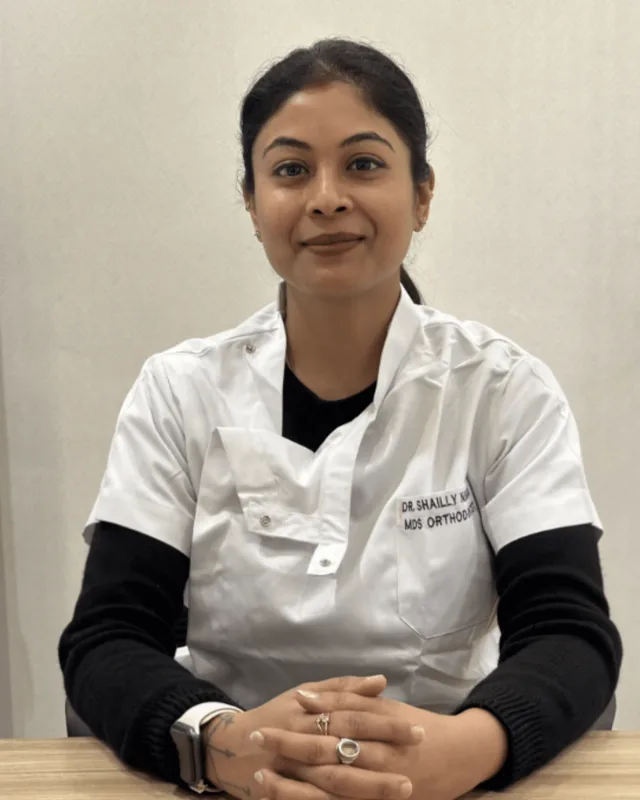
Dr. Shailly Nimbark (BDS, MDS Orthodontist, Dream Smile Dental Clinic, Indore) uses these 10 clinical indicators to assess orthodontic need.
1. Crowding — Teeth Overlapping or Twisting
When there is not enough space in the jaw for all your teeth, they crowd together and rotate to fit. Crowded teeth are harder to clean: a toothbrush cannot reach the surfaces where teeth overlap, so plaque accumulates and causes decay and gum disease in those hidden areas.
Do you need braces? Yes, especially if any two teeth are significantly overlapping. Crowding never resolves on its own — it usually worsens with age.
2. Spacing — Gaps Between Teeth
Gaps between teeth (diastema) occur because of missing teeth, teeth that are too small for the jaw, or a habit like thumb-sucking. The most common is the midline gap between the two upper front teeth.
Gaps are a cosmetic concern but also a functional one — food packs into the spaces and increases gum disease risk. Braces, clear aligners or veneers can close gaps, depending on their size.
3. Overbite — Upper Front Teeth Cover Too Much of the Lower
A deep overbite means the upper front teeth overlap the lower front teeth by more than 3–4 mm (normal overlap is 1–3 mm). In severe cases, the lower front teeth bite into the roof of the mouth. Deep overbite causes excessive wear of the lower front teeth and puts strain on the jaw joint.
4. Underbite — Lower Jaw Protrudes Forward
When the lower front teeth sit in front of the upper front teeth, it is called an underbite. This causes a "bulldog" appearance and makes chewing and speaking clearly difficult. Underbites are best corrected during childhood when the jaw is still developing — they become much harder (and sometimes require surgery) if left until adulthood.
5. Crossbite — Upper and Lower Teeth Do Not Meet Correctly
In a crossbite, some upper teeth sit inside the lower teeth instead of outside. A crossbite can be on one side (unilateral) or both sides (bilateral). It causes the jaw to shift to one side when biting, which wears teeth unevenly and strains the jaw joint. Left untreated, crossbite causes permanent asymmetric jaw growth in children.
6. Open Bite — Front Teeth Do Not Touch When Mouth Is Closed
If there is a gap between your upper and lower front teeth when you close your mouth, it is called an anterior open bite. The back teeth may be touching but the front teeth are not — making it impossible to bite into food like a sandwich or apple cleanly. Open bites are often caused by thumb-sucking, tongue thrusting or prolonged pacifier use.
7. Jaw Clicking, Pain or Jaw Fatigue (TMJ Symptoms)
Clicking, popping, locking or aching in the jaw joint (temporomandibular joint, TMJ) is often associated with a misaligned bite. When the teeth do not meet evenly, the muscles and joints that control chewing are overworked. Orthodontic treatment corrects the bite and significantly reduces TMJ strain in many patients.
8. Difficulty Biting, Chewing or Speaking
If you consistently bite your cheek or tongue while eating, have difficulty pronouncing certain sounds (especially "s", "th"), or find that certain foods are genuinely difficult to chew, a bite problem is likely. These are functional problems — not cosmetic ones — and they only worsen with time.
9. Breathing Through the Mouth or Snoring
Chronic mouth breathing (especially in children) can affect jaw development — narrowing the palate and crowding the teeth. An orthodontist can use palatal expanders during growth years to widen the jaw, improve nasal airway space, and create room for teeth — all while the jaw is still growing. This is why an orthodontic check at age 7 is recommended even if teeth look straight.
10. Baby Teeth Lost Too Early or Too Late
Baby teeth act as space-holders for permanent teeth. Losing a baby tooth too early (before the permanent tooth is ready to erupt) leaves a gap that neighbouring teeth drift into, blocking the permanent tooth's path. Losing baby teeth too late (after 13–14 years) can push permanent teeth out of alignment. Both scenarios benefit from early orthodontic assessment.
At What Age Should You Get Braces?
| Age Group | What Is Done |
|---|---|
| Age 7 (early assessment) | Identify developing problems. Interceptive treatment if needed (expanders, space maintainers). Prevents complex treatment later. |
| Age 11–14 (ideal) | All permanent teeth present. Jaw still growing. Braces work fastest and give the best results at this age. |
| Adults (any age) | Braces or clear aligners work at any age. Treatment may take slightly longer. Clear aligners are popular with adults for discretion. |
Braces vs Clear Aligners — Which Is Right for You?
The right choice depends on the severity of your case, your age and your lifestyle. Metal braces work for all case types. Clear aligners are ideal for mild to moderate cases in adults who value discretion. Dr. Nimbark will give you an honest recommendation — not the most expensive option.
See our detailed guide: Clear Aligners Cost in Indore 2026 | Braces at Dream Smile
FAQs
Can adults get braces if they never had them as children?
Absolutely. There is no upper age limit for orthodontic treatment. Adult teeth move in response to the same biological process as children's teeth — it just takes slightly longer. We have patients in their 40s and 50s completing orthodontic treatment successfully.
What happens if I ignore the need for braces?
Minor misalignment tends to worsen over time. Crowded teeth accumulate more plaque, increasing decay and gum disease risk. A bad bite causes uneven enamel wear, TMJ problems and jaw pain. Crossbites cause permanent jaw asymmetry in growing children. It is not purely cosmetic — it is a dental health issue.
How do I know if I need braces or just veneers?
Veneers correct shape and colour but do not move teeth or correct a bite. If your bite is healthy and you only want to change appearance slightly, veneers may be appropriate. If you have crowding, spacing, or any bite issue, braces first gives a better, longer-lasting result than covering the problem with veneers.
How much do braces cost in Indore?
Metal braces: Rs 18,000–35,000. Ceramic braces: Rs 28,000–50,000. Clear aligners: Rs 45,000–90,000. Fees include all adjustments. 30% off currently available at Dream Smile. See our full braces cost guide.
Not sure if you need braces? Book a free orthodontic assessment with Dr. Shailly Nimbark, MDS Orthodontist, at Dream Smile Dental Clinic, Lokmanya Nagar, Indore. We will show you exactly what is happening with your bite and what (if anything) needs to be done — no pressure. Book your free assessment